Gold Investment News TV

.

Friday, May 09, 2014

Senators blast watchdogs over widespread gold investment fraud

BY DOUWE MIEDEMA AND DIANE BARTZ
WASHINGTON Wed Apr 30, 2014 6:42pm EDT
Article from http://www.reuters.com/


(Reuters) - Lawmakers scolded federal regulators for not doing enough to prevent scam artists from luring retirees into risky investments in precious metals, fraud from which has cost victims an estimated $300 million since 2001.

A convicted felon, a victim and two law enforcement officials testified at a hearing of the Senate Special Committee on Aging on Wednesday, to discuss a report that found an estimated 10,000 Americans - mostly elderly - had fallen prey to such schemes.

One of the regulators, the Commodity Futures Trading Commission, pledged to start informing consumers better. It also said nobody had been sent to jail in the 21 cases of precious metals fraud it had prosecuted.

"The first line of defense is not consumer education. The first line of defense is putting the crooks in prison," said Senator Claire McCaskill, a Missouri Democrat.

Both the CFTC, which regulates U.S. derivatives trading, and the Federal Trade Commission, which enforces laws against false advertising, have investigated and shut down such companies, but the two have no criminal prosecution authority.

McCaskill urged the two regulators to rely less on federal prosecutors and work more with state district attorneys.

Bill Nelson, the Florida Democrat who heads the committee, linked the report to the confirmation of Timothy Massad in his role as CFTC chairman.

"Before I will allow consideration of his nomination in front of the Senate I would like to have a conversation with him," he said. Massad has been confirmed by a different Senate panel, but it is unclear when the full Senate will do so.

Karl Spicer, convicted for his role in a Florida-based scheme to rip off investors though the sale of silver and other precious metals, said that the agencies inspired little fear in the people working on such scams.

"With all due respect to the civil authorities, the people that I have encountered ... don't really respect the civil authority bans," Spicer said. "The gentleman I was with had a CFTC ban, he cooperated; he had a ban and he still went about doing business the very next day."

A group of attorneys helped them evade the rules, for instance, by continuing the business under somebody else's name, he said, adding that the schemes were widespread.

In a typical scam, the report said, a telemarketer phones a potential victim, often a retiree, and gives what is purported to be privileged information about a likely rise in the future price of gold, or silver, or other metals.

The end result is often that a retiree may borrow money at a high interest rate to invest in the metal, pay commissions and storage fees and then lose his or her stake, often thousands of dollars, the report said.

The scams, like many other kinds of fraud, have become more prevalent since the 2008 financial crisis as retirees sought relatively safe investment opportunities. Some seniors, faced with years of near-zero interest rates, have sought out ways to make their retirement nest eggs go further.

Many of the precious metals firms are based in Florida, and the state's Office of Financial Regulation has gone after seven companies whose customers lost more than $54 million, according to the report. Officials in California, Minnesota, North Carolina and Texas have also cracked down on such firms.

In simpler cases, customers are sold coins that are priced at considerably more than their market value. Advertisements for such sales are staples of late-night television programming.

(Reporting by Diane Bartz; editing by G Crosse, Ros Krasny and Ken Wills)


DOUWE MIEDEMA AND DIANE BARTZ
WASHINGTON Wed Apr 30, 2014 6:42pm EDT
Article from http://www.reuters.com/

Friday, May 02, 2014

Improving US Economy Hinders Gold Price

By Vivien Diniz   
Thursday May 1, 2014, 4:05pm PDT
Article from http://goldinvestingnews.com/


The Federal Reserve once again didn’t do gold any favors this week. Spot gold was down on Thursday to $1,279.24 per ounce on more outflows from gold exchange-traded funds (ETFs) after the Fed stuck with its plan to reduce its monthly bond-buying program. The yellow metal touched a one-week low of $1,277.09 earlier in the day.

The Fed’s decision to reduce its monthly bond purchases was reinforced by its view that the US economy is on the path to recovery. This week, US data showed that consumer spending was at its highest level in over four and a half years in March, while factory activity increased in April. Market watchers will be on the lookout for US nonfarm payrolls data, scheduled to be released on Friday.

Get the latest Gold Investing News articles delivered to your email inbox. Learn more
Email

The gold-backed SPRD Gold Trust ETF (ARCA:GLD) saw roughly 4.19 tons of outflows on Wednesday, marking its biggest drop in two weeks. That suggests investor confidence has not quite been restored when it comes to gold. ETF holdings have been on a decline for the past several weeks, with a drop of 30 tons over the last month and a half.

Earlier this week, when gold touched about $1,300 on continued tension between Russia and Ukraine, ETFs seemed like a good idea. Unfortunately, ETFs seem to be caught in the middle of a “tug of war” between the former Soviet nation and the US.

“Total holdings in exchange traded products backed by physical gold fell by 0.6 tons as investors in the yellow metal continue to seek protection from a potential escalation in Ukraine against the risk of further losses as the US economy continues to improve, thereby offering better investment opportunities elsewhere,” said Ole Hanson, head of commodity strategy at Saxo Bank.

US slipping from top spot

Despite the improving US economy, a report out of the World Bank suggests that China’s economic growth is rapidly gaining on that of the US, so much so that China could soon hold the top spot as world’s biggest economy.The US has held the top spot as world’s largest economy for more than a century, and could be surpassed by China as early as this year. Economists, as the Financial Times explains, had previous thought that China would only pull ahead of the US in 2019. The Bank also highlights that India has climbed up the ranks, taking the place of third-largest economy away from Japan.

Company news

This week, merger talks between Barrick Gold (TSX:ABX) and Newmont Mining (TSX:NMC) came to an end. As CTV News reported, both companies blamed each other earlier this week for the collapse of merger talks, which could have resulted in the a combination of the world’s largest gold producers. In what ended up being a war of words, Barrick’s chairman, Peter Munk, pointed to “cultural differences,” adding that Newmont is an extremely conservative and risk-averse company, which made negotiations frustrating.

On Wednesday’s annual shareholder meeting, Munk stepped down from his post after more than 30 years.

Vancouver gold miner Goldcorp (TSX:G) announced its Q1 earnings on May 1. They show a decline due to the lower gold price, despite the company’s increase in gold production.

On Thursday, Corvus Gold (TSX:KOR,OTCQX:CORVF) announced the results from the ongoing Phase 1 drill program at the North Bullfrog project in Nevada. Corvus notes assay results include the full intercept of hole NB-14-380, as well as four recently completed holes on the new West Vein zone. Highlights from the new West Vein zone include hole NB-14-384, which intersected 4.5 meters of 17 g/t gold and 140 g/t silver 50 meters along strike from NB-14-380. Meanwhile, hole NB-14-382 encountered 4.7 meters of 4.6 g/t gold and 0.5 meters of 181 g/t gold 25 meters down dip from NB-14-380.

Detour Gold (TSX:DGC) reported its first-quarter results on April 30. They indicate that Detour met expectations, producing 107,154 ounces of gold for the quarter. The company also saw revenues come in at $110 million from the sale of 84,560 ounces. In addition, Detour closed some equity financing for gross proceeds of C$173 million and repaid $40 million in debt.

Paramount Gold and Silver (TSX:PZG,NYSE:MKT:PZG) discovered a new set of structures to the south of the richly endowed Guazapares Megastructure on the San Miguel project in Mexico. Preliminary drilling has intersected sizable widths of high-grade precious metals.

Also this week, Klondex Mines (TSX:KDX) announced the results of its PEA for the Fire Creek project in Nevada. The assessment points to low all-in sustaining cash costs of $636 per ounce of gold and a $157.3-million after-tax cash flow.

Securities Disclosure: I, Vivien Diniz, hold no investment interest in any of the companies mentioned.


Vivien Diniz   
Thursday May 1, 2014, 4:05pm PDT
Article from http://goldinvestingnews.com/

Tuesday, April 22, 2014

Investing In Gold Miners Different Than Gold


By Spencer Bogart
April 21, 2014
From http://www.etf.com/sections/news/

Investing in gold miners should never be conflated with investing in gold.


Gold miners’ attractiveness as an investment is certainly debatable, but one thing is not: Investing in gold miners is very different than investing in gold itself. Gold miner equity is far more volatile than gold, and only weakly correlated to it.

Worse, the Market Vectors Gold Miners ETF (GDX | B-57) has declined 34 percent since its inception in May 2006. Meanwhile, gold itself has done quite well, despite a recent downturn: The SPDR Gold ETF (GLD | A-100)—which holds physical gold—returned 95 percent over that same period.

Worse still is that gold mining ETFs are a feature in America’s Riskiest ETFs, because not only are they more volatile than gold, they’re more volatile than the vast majority of ETFs on the market. In that particular report, it was the Market Vectors Junior Gold Miners ETF (GDXJ | D-29)—a smaller, riskier version of GDX—that was among the riskiest ETFs in the country.

The statistics keep getting worse for gold miners: Relative to earnings, they’re also among the most dearly priced (expensive) ETFs anywhere—as was noted in our report “The Most Richly Valued ETFs.” To be fair though, gold itself doesn’t produce any earnings, so the theoretical P/E on GLD would be infinity.

Again, there are definitely some sound theses for investing in gold miners, but the underlying point is that investing in gold miners is drastically different than investing in gold. Any investment thesis centered on gold should not be conflated with one focused on gold miners.

Spencer Bogart
April 21, 2014
From http://www.etf.com/sections/news/

Friday, May 17, 2013

Gold’s dichotomy: Investment demand plunges, but consumers keep buying


Peter Koven | 13/05/16 | Last Updated: 13/05/16 5:46 PM ET
Article from http://business.financialpost.com/


Today’s gold market is being defined by two trends: aggressive selling by investors in North America through exchange-traded funds, and aggressive buying by consumers in Asia.

Gold is tanking again today, but Soros at least saw it coming

Billionaire investor George Soros joined Northern Trust Corp. and BlackRock Inc. in cutting holdings of exchange-traded products backed by gold before a bear market in prices last month, while John Paulson maintained a stake that lost about US$165 million in the first quarter.

But for now, the ETF investors are overwhelming everyone else.

Gold prices settled below US$1,390 an ounce on Thursday, and after five rough trading days in a row, they are approaching the lows that were reached during last month’s dramatic collapse.

Amid that turmoil, the World Gold Council (WGC) issued a report that shines a light on how rapidly investors are dumping their holdings.

The report shows that overall gold demand fell 13% in the first quarter of 2013 compared to the same period a year ago. While that is not too bad on the surface, investment demand fell an astounding 49%. Investors sold a net 176.9 tonnes of gold through ETFs in the quarter, or roughly US$9.3-billion worth of the yellow metal.

The gold market is very small, with total demand of about 1,000 tonnes per quarter, according to the council. That means fluctuations in ETF holdings can have an outsized effect on the paper price.

“When the hedge funds and other investment funds turn negative, it just overwhelms the physical demand,” said George Topping, an analyst at Stifel Nicolaus.

Given that April was the most volatile month for gold since 2008, investment demand could wind up being even worse in the current quarter.

The ETF sell-off masked the fact that underlying physical gold demand has been strong. And in the case of China and India, it has been remarkably strong.

The WGC reported that Chinese consumer demand rose 20% in the first quarter, while Indian demand rose 27%. It is proof that Asian customers and investors are eager to jump into the market in search of a bargain whenever prices decline. That has been an ongoing theme throughout the gold bull market


In particular, Chinese gold imports have been going through the roof. Data released last week showed that China imported 223.5 tonnes (or 7.9 million ounces) from Hong Kong in March, crushing the previous monthly record of 114.3 tonnes that was set last December. Gold bugs have repeatedly pointed to these figures as evidence that underlying demand in strong, regardless of the price movements on the Comex.

Physical demand has been solid in other countries as well. In the U.S., the council said that demand for bars and coins rose 40% in the first quarter, while jewellery demand increased for the first time since 2005. Global jewellery demand reached a record 551 tonnes, or US$28.9-billion.

Central banks also added 109 tonnes of gold in the quarter, the ninth straight quarter in which they boosted their reserves.

“Overall, diverse gold demand across both sectors and geography remains strong and is likely to stay strong in the future,” Marcus Grubb, the council’s managing director of investment, said in a presentation.

But even if physical demand can be counted on to create a price floor when the investment funds sell, no one is certain what that floor is. Experts said that the next technical support level for gold is about US$1,300, but it broke through support levels last month when it plunged 13% in two days.

If prices fall to the US$1,200 range and stay there for an extended period, analysts have warned that gold miners will be forced into major restructurings of their operations, including mine closures. They are already slashing their capital spending budgets to preserve their balance sheets.


Peter Koven | 13/05/16 | Last Updated: 13/05/16 5:46 PM ET
Article from http://business.financialpost.com/

Wednesday, May 15, 2013

Investors can now invest in SBI gold fund in quantity

Dileep Athavale, TNN | May 14, 2013, 03.10PM IST
Article from http://timesofindia.indiatimes.com/business/india-business/


PUNE: SBI Mutual Fund has introduced Gold Accumulation Facility on SBI Gold Fund. The facility would allow investors to invest in the scheme based on a specific quantity of SBI Gold Exchange Traded Schemes (SBI GETS) unit, wherein unit of SBI GETS represent approximately one gram of gold.

So far, SBI Gold Fund investors could invest only by a specific amount and not by quantity. With the introduction of gold accumulation facility, it would now be additionally possible for investors to invest on the basis quantity of gold (grammage) via the same systematic investment plan (SIP) or Systematic Transfer Plan (STP) route.

The gold accumulation facility can be used by investors through SIP and STP route. The amount will be calculated for each SIP/STP instalment into SBI Gold Fund, based on the net asset value (NAV) of SBI GETS and the number of units as specified by investor.

Deepak Chatterjee, managing director and chief executive officer, SBI Funds Management Private Limited said, "A customer research says that investors generally prefer investing in gold on basis of quantity more than its value. With the Gold Accumulation Facility, SBI Gold Fund now offers one of the best investment opportunities to the investors. This is the best option for the investor who aspires for a specified quantity of gold to be accumulated over a fixed period."

Dileep Athavale, TNN | May 14, 2013, 03.10PM IST
Article from http://timesofindia.indiatimes.com/business/india-business/

Monday, May 13, 2013

Gold doesn’t always glitter as investment

By Guest Columnist on May 8, 2013 at 12:47 pm
Article from http://stillwatergazette.com/2013/05/08/gold-doesnt-always-glitter-as-investment/


A promise you can trust is as “good as gold.” The highest level of performance is known as the “gold standard.” If you’re married for 50 years, you celebrate your “golden anniversary.” Clearly, gold carries connotations of wealth, value and beauty. But as an investment, is gold always a dazzling success story?

Many people apparently think so. If you were to look at the first decade of this century, you’d have said these investors had the numbers on their side, because gold prices shot up from around $280 per ounce in 2000 to $1,888 an ounce in August 2011. And, for the most part, this same decade was not a good one for the stock market, so it’s not hard to see why a generation of investors might think that gold is perpetually a good alternative to equities.

Of course, the contrasting movements of gold and equity prices during that decade are not unrelated. When the stock market is volatile, investors often flee to gold as a “safe harbor,” and the increased demand drives gold prices up. So it perhaps shouldn’t be that surprising that the stock market rally we’ve experienced the last few years has lessened the hunger for gold. And yet, a lot of investors are surprised — and even stunned — that gold prices have now fallen about 20 percent from their record high in August 2011. After all, even with stocks performing strongly, isn’t gold still a good investment just because it is gold?

There’s no simple answer to this question. On the one hand, gold is a finite and relatively rare commodity, so it will likely always maintain considerable value. However, as recent history has shown, that value will not always move up. Like any investment, gold will rise and fall over time — and sometimes, those drops, like the gains, can be pretty big.

Also like any other investment, gold carries its own set of special risks, which will vary, depending on the specific investment vehicle.

For example, if you bought a gold futures contract (an obligation to buy gold at a pre-determined future date and price), you could lose money if gold falls, because you’ll still be obligated to complete your contract at the higher, agreed-upon price. If you purchased physical gold, in the form of coins, bullion or bars, you’d face storage, security, insurance and liquidity issues. As an alternative, you could buy shares of stock in gold mining companies, but you need to do a lot of research beforehand, because some of these companies may still be in the gold-exploring stage — and there’s no guarantee that their explorations will lead to profitable discoveries.

Also, even when its price is considerably lower than it is today, gold is still a fairly expensive investment compared to other choices.

Still, despite these considerations, you might find gold can be a useful part of your portfolio. If you didn’t want to own physical gold or invest in futures contracts, you could purchase shares of a “precious metals” mutual fund.

However you choose to own gold, keep in mind that this type of investment should probably only make up a small percentage of your portfolio, with the exact amount depending on your goals, risk tolerance and time horizon. Instead of counting on gold as a sure ticket to investment success, seek to maintain a diversified portfolio containing high-quality stocks, bonds, government securities and other vehicles.

Gold prices might have fallen sharply, but they can certainly turn around at some point.  If and when that happens, try to maintain a proper perspective — namely, be aware that when purchased in a suitable vehicle and in appropriate proportions, gold can possibly benefit your portfolio, but it is not a “golden ticket” to never-ending gains.

This article is provided by Eric St. Martin, a senior financial associate at RBC Wealth Management in Stillwater, and was prepared by or in cooperation with RBC Wealth Management.

Guest Columnist on May 8, 2013 at 12:47 pm
Article from http://stillwatergazette.com/2013/05/08/gold-doesnt-always-glitter-as-investment/

Friday, May 10, 2013

Gold investing for the long haul


5/10/2013 1:35:03 PM | Pablo Paciello, bulliondeals.co.nz
Article from: http://www.stockhouse.com/columnists/2013/may/10/gold-investing-for-the-long-haul.aspx#PFYWJBIXo2S2vY4t.99 


It appears that most of the world's gold mines have been discovered

Now is the right time to invest! Many people looking to start investing make the mistake of trying to wait until prices drop to a certain point before buying. While this method can sometimes pay off, often investors simply lose out as markets rise. Time and time again, markets have proven that good investments tend to rise over time. Bad investments, obviously, lose value but if you are considering a certain investment, chances are you already believe it's a good bet.

Generally speaking, it's better to be in than out. Of course, this is a rule of thumb and there may be times when it's better to wait it out and see how markets react to certain news or developments. Still, you shouldn't hesitate when you think stock, precious metal, or another asset is a good investment. Many people make the mistake of waiting for gold or stock prices to drop by a few dollars, only to wallow in regret as prices rise. Instead of living with regret, you should invest confidently!

Further, it's usually best to invest with a long term view. For most investors it is easier to make money by holding onto an asset, such as silver, for a long time and watching as its value slowly appreciates. Many big name investors, such as Warren Buffet, invest in assets they intend to hold onto for years to come. If this is the case, a few dollars difference in the purchasing price point will have little impact.

Unless you see a great opportunity to invest in something that might generate short-term profits, your best bet is to invest in something that you believe will gradually increase in value over time. The problem with investments made based on short-term gains is that the risks are much higher. Even professional investors regularly get burned on high-risk short-term investments, so if you are simply trying to oversee your retirement account or personal wealth, high-risk short-term investments simply don't make sense.

Instead, you should ask yourself which commodities, stocks, and other assets will be more valuable in 10 years. Let's examine gold as an example. So far, it appears that most of the world's gold mines have been discovered and many of them have already been fully exploited. While certainly there will be discoveries in the future, there is little chance that these discoveries will be flooding global markets with cheap gold. In a sense, we could say that the supply of gold is limited and is now becoming fully tapped.

Markets are determined by supply and demand, and so far we have good reason to believe that future supplies of gold will be limited. Now what about demand? Determining demand is never an easy thing to accomplish, however, we do know that the world's population is growing in size and wealth. As the world's population increases in size there will simply be more people to buy gold. And as the world's population increases in wealth there will be more people who actually have the money to purchase gold. This should lead to an increased demand for the precious metal.

At least based on this brief analysis, gold would appear to be a good long-term investment. Of course, that doesn't mean you should rush out and purchase gold right away. Many analysts had been arguing that gold prices were inflated and in April of 2013 they were proven right. Gold prices slid from just under $1,900NZD per troy ounce to under $1,600NZD. In this case, the short-term analysis suggests that gold had formed a bit of a bubble, though in the long run demand for gold should continue to rise and gradually push its prices upwards. In fact, if the gold bubble has completely deflated, now might be the best time to invest.

Choosing when to invest is always an important decision and one that should not be made lightly. If you are waiting for prices to drop on investments that you believe will demonstrate long term growth, you should seriously consider investing sooner rather than later. Don't let the world and rising markets pass you by all because you hope to pick up an ounce of gold or silver for $20 cheaper! Most likely, you'll simply be left in the dust as other investors reap the profits of rising markets. 

ABOUT THE AUTHOR

Pablo Paciello, bulliondeals.co.nz

Bullion Deals was established in New Zealand with the purpose of providing a superior bullion buying experience and offering the best deals in the country. Bullion Deals stocks a range of Gold and Silver bars, coins and bullion products. Visit www.bulliondeals.co.nz to find out more and to check out their range of products. 

Pablo Paciello, bulliondeals.co.nz
Article from: http://www.stockhouse.com/columnists/2013/may/10/gold-investing-for-the-long-haul.aspx#PFYWJBIXo2S2vY4t.99 

Wednesday, May 08, 2013

Why gold is still a worthy investment despite selloff


By Atlas Capital / Covestor
Published May 07, 2013
From http://www.foxbusiness.com/investing/


A lot has been said and written about the recent fall in gold's price.


Gold is an interesting asset.

· It pays a negative return (you need to pay someone to secure it).
· It's not used widely for industrial purposes.

Warren Buffett observes: “Gold gets dug out of the ground in Africa, or someplace. Then we melt it down, dig another hole, bury it again and pay people to stand around guarding it.

It has no utility. Anyone watching from Mars would be scratching their head.”

Gold can only be rationalized as a store of value, an alternative to fiat money that we have all grown so accustomed to. And it tends to perform well during environments of market distress.

As an ‘insurance’ policy during these times of distress, we feel gold has an appropriate place in an investor's portfolio (less than 3% of total assets). As with any well diversified portfolio, it's important not to ‘compartmentalize’ any individual holding; focus on how the overall portfolio is performing.

The post Why gold is still a worthy investment despite selloff appeared first on Smarter Investing

Covestor Ltd. is a registered investment advisor. Covestor licenses investment strategies from its Model Managers to establish investment models. The commentary here is provided as general and impersonal information and should not be construed as recommendations or advice. Information from Model Managers and third-party sources deemed to be reliable but not guaranteed. Past performance is no guarantee of future results. Transaction histories for Covestor models available upon request. Additional important disclosures available at http://site.covestor.com/help/disclosures.


By Atlas Capital / Covestor
Published May 07, 2013
From http://www.foxbusiness.com/investing/

Monday, May 06, 2013

Gold, Long a Secure Investment, Loses Its Luster


Weighing gold nuggets in the Philippines.

By NATHANIEL POPPER
Published: April 10, 2013http://www.nytimes.com/

Below the streets of Lower Manhattan, in the vault of the Federal Reserve Bank of New York, the world’s largest trove of gold — half a million bars — has lost about $75 billion of its value. In Fort Knox, Ky., at the United States Bullion Depository, the damage totals $50 billion.

And in Pocatello, Idaho, the tiny golden treasure of Jon Norstog has dwindled, too. A $29,000 investment that Mr. Norstog made in 2011 is now worth about $17,000, a loss of 42 percent.

“I thought if worst came to worst and the government brought down the world economy, I would still have something that was worth something,” Mr. Norstog, 67, says of his foray into gold.

Gold, pride of Croesus and store of wealth since time immemorial, has turned out to be a very bad investment of late. A mere two years after its price raced to a nominal high, gold is sinking — fast. Its price has fallen 17 percent since late 2011. Wednesday was another bad day for gold: the price of bullion dropped $28 to $1,558 an ounce.

It is a remarkable turnabout for an investment that many have long regarded as one of the safest of all. The decline has been so swift that some Wall Street analysts are declaring the end of a golden age of gold. The stakes are high: the last time the metal went through a patch like this, in the 1980s, its price took 30 years to recover.

What went wrong? The answer, in part, lies in what went right. Analysts say gold is losing its allure after an astonishing 650 percent rally from August 1999 to August 2011. Fast-money hedge fund managers and ordinary savers alike flocked to gold, that haven of havens, when the world economy teetered on the brink in 2009. Now, the worst of the Great Recession has passed. Things are looking up for the economy and, as a result, down for gold. On top of that, concern that the loose monetary policy at Federal Reserve might set off inflation — a prospect that drove investors to gold — have so far proved to be unfounded.

And so Wall Street is growing increasingly bearish on gold, an investment that banks and others had deftly marketed to the masses only a few years ago. On Wednesday, Goldman Sachs became the latest big bank to predict further declines, forecasting that the price of gold would sink to $1,390 within a year, down 11 percent from where it traded on Wednesday. Société Générale of France last week issued a report titled, “The End of the Gold Era,” which said the price should fall to $1,375 by the end of the year and could keep falling for years.

Granted, gold has gone through booms and busts before, including at least two from its peak in 1980, when it traded at $835, to its high in 2011. And anyone who bought gold in 1999 and held on has done far better than the average stock market investor. Even after the recent decline, gold is still up 515 percent.

But for a generation of investors, the golden decade created the illusion that the metal would keep rising forever. The financial industry seized on such hopes to market a growing range of gold investments, making the current downturn in gold felt more widely than previous ones. That triumph of marketing gold was apparent in an April 2011 poll by Gallup, which found that 34 percent of Americans thought that gold was the best long-term investment, more than another other investment category, including real estate and mutual funds.

It is hard to know just how much money ordinary Americans plowed into gold, given the array of investment vehicles, including government-minted coins, publicly traded commodity funds, mining company stocks and physical bullion. But $5 billion that flowed into gold-focused mutual funds in 2009 and 2010, according to Morningstar, helped the funds reach a peak value of $26.3 billion. Since hitting a peak in April 2011, those funds have lost half of their value.

“Gold is very much a psychological market,” said William O’Neill, a co-founder of the research firm Logic Advisors, which told its investors to get out of all gold positions in December after recommending the investment for years. “Unless there is some unforeseen development, I think the market is going lower.”

Gold’s abrupt reversal has also been painful for companies that were cashing in on the gold craze. In the last year, two gold-focused mutual funds were liquidated after years of new fund openings, Morningstar data shows. Perhaps the most famous company to come out of the 2011 gold rush, the retail trading company Goldline, has drastically cut back its advertising on cable television, lowering spending to $3.7 million from $17.8 million in 2010, according to Kantar Media.

Goldline agreed to pay $4.5 million last year to settle charges brought by the city attorney of Santa Monica, Calif., accusing the company of running a bait-and-switch operation. Goldline did not respond to requests for comment for this article.

But the worst news for gold is probably good news for the broader economy, which, though still struggling to grow, has recovered from its lows.

“As the economy improves, the demand for gold as a financial hedge declines more than the fundamental demand for gold jewelry increases,” said Daniel J. Arbess, a partner at Perella Weinberg Partners, who sold off his fund’s large stake in gold in the fourth quarter of 2012.

Investment professionals, who have focused many of their bets on gold exchange-traded funds, or E.T.F.’s, have been faster than retail investors to catch wind of gold’s changing fortune. The outflow at the most popular E.T.F., the SPDR Gold Shares, was the biggest of any E.T.F. in the first quarter of this year as hedge funds and traders pulled out $6.6 billion, according to the data firm IndexUniverse. Two prominent hedge fund managers who had taken big positions in gold E.T.F.’s, George Soros and Louis M. Bacon, sold in the last quarter of 2012, according to recent regulatory filings.

“Gold was destroyed as a safe haven, proved to be unsafe,” Mr. Soros said in an interview last week with The South China Morning Post of Hong Kong. “Because of the disappointment, most people are reducing their holdings of gold.”

Gold’s most vocal bulls say gold doubters are losing faith too easily. Peter Schiff, the chief executive of the investment firm Euro Pacific Capital, said that he still expected gold to hit $5,000 an ounce within a few years because, he said, the world is headed for a period of dangerous hyperinflation.

“People believe the U.S. economy is recovering. It’s not,” said Mr. Schiff.

The most famous investor who is standing by gold is John Paulson, the hedge fund manager who made a fortune betting against the American housing market. His $900 million gold fund reportedly dropped 26 percent in the first two months of this year.

Mr. Paulson’s losses were particularly severe because he bet heavily on gold mining companies, which have fallen more sharply than gold itself.

Mr. Norstog, in Pocatello, made a similar mistake. He put his money in a gold fund that was focused on mining company stocks.

“If I had to do it all over again, I would have just bought the gold,” Mr. Norstog said. “At least that way I could have run my fingers through the glittering coins.”


A version of this article appeared in print on April 11, 2013, on page B1 of the New York edition with the headline: A Sure Bet Loses Its Luster.

By NATHANIEL POPPER
Published: April 10, 2013http://www.nytimes.com/

Thursday, April 12, 2012

Gold Investment in 2012: The Bullish and Bearish Signals - 12 April 2012


Article from The Bullion Bult

Key factors from this week's GFMS 'Gold Survey 2012'...

THIS WEEK saw the launch of 'Gold Survey 2012' by Thomson Reuters GFMS, the world's foremost research firm focusing on precious metals. For those weighing up the pros and cons of making a Gold Investment this year there were both bullish and bearish signals, writes Ben Traynor at BullionVault.

Here are some highlights:

Bullish Signals

1. Gold Investment demand is expected to set a new record in 2012

GFMS expects Gold Investment demand to be the main driver of Gold Prices this year, as it was in 2011. Furthermore, the consultancy expects investment demand for gold to set a fresh all-time high of close to 2000 tonnes in Gold Bullion terms.

A key driver of Gold Investment, says GFMS, is likely to be ongoing loose monetary policies adopted by the world's central banks.

"A corollary of all this monetary largesse," says GFMS's global head of metals analytics Philip Klapwijk, "is fears about resurgent inflation, and that becomes all the more likely if oil prices motor higher should tensions get any worse between Iran and the US."

2. Physical Gold Investment demand continued to be strong last year

Investment demand for physical gold saw "an excellent performance" last year, Klapwijk told the audience at the London launch of 'Gold Survey 2012'.

Europe, China, Thailand and the Indian subcontinent all saw growth in physical gold bar investment (investors in North America, as Klapwijk pointed out, tend to prefer Gold Coins to Gold Bars).

On a global level, combined demand for coins and bars was 1543 tonnes – a 30% gain on 2010, and a new all-time record. Indeed, the majority of Gold Investment in 2011 took the form of physical investment, GFMS says.

The significance of this is that investments in physical gold tend to represents "stickier" investments than other forms of getting exposure to the metal (for example buying Gold Futures) – meaning it would probably take more for such investors to exit the positions they've built.

 That said, there is obviously a limit to most investors' stickiness. A lot will depend on whether, as GFMS expects, the economic environment will continue to be supportive of Gold Investment, with negative real interest rates and fears of inflation prevailing in most parts of the world.

3. Scrap supply appears to be flat

On a global level, scrap supply fell by around 50 tonnes 2011 – equivalent to almost two thirds of the year's Gold Mining production growth. This was the second consecutive year-on-year fall for scrap supply.

Only Europe saw significant growth in scrap Gold Bullion supply last year (old jewelry, gold watches etc.), most likely the result of distressed selling prompted by the Eurozone crisis.

North America and Latin America meantime posted modest scrap supply growth. East Asia and the Indian subcontinent meantime saw scrap supply fall, as did the Middle East, where it dropped by over 100 tonnes.

Although GFMS says it expects scrap supply to rise this year, another traditional source of supply – central banks – is expected to be absent (see below). GFMS points out there was a "secular increase" in supply from scrap, producer hedging and official central bank sales between 1987 and 1999 – a factor which it reckons contributed to the lackluster Gold Price during that period. 

By contrast, supply from these sources has been flat since 2000, despite a sharp jump in scrap supplies at the onset of the financial crisis. This period in flat supply has broadly coincided with gold's bull market.

4. Central banks are expected to keep Buying Gold

GFMS expects central banks to remain net gold buyers this year, although there may be a slight dip on last year's figure, with net official sector buying having risen 491% year-on-year in 2011.

The swing to net buying by central banks is a key factor behind the flat supply picture of recent years that was noted above. Signatories to the Central Bank Gold Agreement have made what GFMS calls "trivial sales" in recent years, while emerging market central banks have been Buying Gold in significant quantities.

Bearish Signals

1. Gold Mining supply is expected to continue growing this year

Worldwide gold mine production rose for the third year running in 2011. Last year saw an annual gain of 2.8%, or 78 tonnes.

New Gold Mining operations contributed 47 tonnes of supply, while Africa was the region that saw the strongest growth, increasing production by 51 tonnes (despite its largest player, South Africa, seeing a five tonne drop).

Gold mine production has entered a "new era", Klapwijk told the London launch, with GFMS expecting a further 3% growth this year. 

2. A lot of Gold Investment is required just to maintain current prices

Rising mine supply contributes to what GFMS terms the gold market "surplus" – the difference between combined mining and scrap supply and fabrication demand (jewelry plus industrial uses).

GFMS estimates that this leaves a "surplus" of gold supply equivalent to around 110 tonnes. Gold Investment therefore needs to take up that slack.

At current prices "purchasers of bullion need to take gold to the tune of $130 billion out of the market for it to clear," said Klapwijk this week. One attendee at the launch asked whether there might be a case for saying many western investors are now overinvested in gold.

Klapwijk agreed such a case could be argued, and that many wealth investors interested in gold have probably already built their positions. He also pointed out that institutions such as pension funds and sovereign wealth funds – where Gold Investment remains relatively rare – could still offer some scope for growth.

3. Hedging activity by miners can now only be a source of supply

For much of the 1980s and 1990s, gold miners would hedge their price risk by selling future production forward to lock in the current price, adding to current supply and putting downwards pressure on the Gold price.

This process went into reverse as the bull market got underway. With Gold Prices rising, producers began to de-hedge, buying back positions and thus contributing to gold demand.

Measured as the total outstanding forwards and loans, plus gold options positions weighted according to their sensitivity to movements in Gold Futures (i.e. an option's delta), producers' overall hedging position last year was equivalent to 157 tonnes of Gold Bullion. Last year was the first year in over a decade that net hedging was positive, the producers in aggregate adding six tonnes to their combined position.

By contrast, hedging positions were equivalent to around 3000 tonnes in 1999 and 2000. Most of the de-hedging – which contributed to the demand side – appears to have been done.

"[Producer hedging] cannot be a source of demand in future," said Klapwijk.

"It can only be a source of supply. The question is: how much supply?"

Klapwijk noted, however, the most of the hedging seen last year appeared to be related to specific mining projects, adding that there seemed little appetite for strategic hedging against a fall in Gold Prices.

4. Gold jewelry demand is expected to fall again

Gold jewelry fabrication demand fell 2.2% in 2011 – though given the rise in Gold Prices, the fact that the fall wasn't larger led GFMS to describe this source of demand as "resilient".

The bulk of fabrication demand was again accounted for by developing countries, where gold jewelry is often bought for investment as much as adornment purposes. 

Although most of the world's regions saw a fall in gold jewelry fabrication in tonnage terms, there was a slight gain in Russia and more significant growth of around 40 tonnes in East Asia, which "boils down to China" said Klapwijk.

Despite this eastwards demand pull, though, GFMS expects gold jewelry consumption to fall again this year, citing high Gold Prices and a slowdown in global growth. Jewelry consumption however "is still expected to remain above 2009's historically depressed level" says GFMS.

The Outlook for Gold Prices

Weighing up the above factors, and many more besides, GFMS forecasts an average Gold Price in 2012 of $1731 per ounce, with a range of $1530 to $1920. 

Klapwijk adds that "a push towards $2000 is definitely on the cards before the year is out, although a clear breach of that mark is arguably a more likely event for the first half of the year".

Of course, short-term gains are not the primary reason most people make a Gold Investment, especially not those Buying Gold in physical bullion form. From developing nations in the East to the quantitatively eased economies of the West, people are turning to gold as a vehicle for defending the value of their wealth and an insurance hedge against tail risks. 

The dynamics behind most Gold Investment will continue to play out well beyond the end of this year.

Key factors from this week's GFMS 'Gold Survey 2012'...

THIS WEEK saw the launch of 'Gold Survey 2012' by Thomson Reuters GFMS, the world's foremost research firm focusing on precious metals. For those weighing up the pros and cons of making a Gold Investment this year there were both bullish and bearish signals, writes Ben Traynor at BullionVault.

Here are some highlights:

Bullish Signals

1. Gold Investment demand is expected to set a new record in 2012

GFMS expects Gold Investment demand to be the main driver of Gold Prices this year, as it was in 2011. Furthermore, the consultancy expects investment demand for gold to set a fresh all-time high of close to 2000 tonnes in Gold Bullion terms.

A key driver of Gold Investment, says GFMS, is likely to be ongoing loose monetary policies adopted by the world's central banks.

"A corollary of all this monetary largesse," says GFMS's global head of metals analytics Philip Klapwijk, "is fears about resurgent inflation, and that becomes all the more likely if oil prices motor higher should tensions get any worse between Iran and the US."

2. Physical Gold Investment demand continued to be strong last year

Investment demand for physical gold saw "an excellent performance" last year, Klapwijk told the audience at the London launch of 'Gold Survey 2012'.

Europe, China, Thailand and the Indian subcontinent all saw growth in physical gold bar investment (investors in North America, as Klapwijk pointed out, tend to prefer Gold Coins to Gold Bars).

On a global level, combined demand for coins and bars was 1543 tonnes – a 30% gain on 2010, and a new all-time record. Indeed, the majority of Gold Investment in 2011 took the form of physical investment, GFMS says.

The significance of this is that investments in physical gold tend to represents "stickier" investments than other forms of getting exposure to the metal (for example buying Gold Futures) – meaning it would probably take more for such investors to exit the positions they've built.

 That said, there is obviously a limit to most investors' stickiness. A lot will depend on whether, as GFMS expects, the economic environment will continue to be supportive of Gold Investment, with negative real interest rates and fears of inflation prevailing in most parts of the world.

3. Scrap supply appears to be flat

On a global level, scrap supply fell by around 50 tonnes 2011 – equivalent to almost two thirds of the year's Gold Mining production growth. This was the second consecutive year-on-year fall for scrap supply.

Only Europe saw significant growth in scrap Gold Bullion supply last year (old jewelry, gold watches etc.), most likely the result of distressed selling prompted by the Eurozone crisis.

North America and Latin America meantime posted modest scrap supply growth. East Asia and the Indian subcontinent meantime saw scrap supply fall, as did the Middle East, where it dropped by over 100 tonnes.

Although GFMS says it expects scrap supply to rise this year, another traditional source of supply – central banks – is expected to be absent (see below). GFMS points out there was a "secular increase" in supply from scrap, producer hedging and official central bank sales between 1987 and 1999 – a factor which it reckons contributed to the lackluster Gold Price during that period. 

By contrast, supply from these sources has been flat since 2000, despite a sharp jump in scrap supplies at the onset of the financial crisis. This period in flat supply has broadly coincided with gold's bull market.

4. Central banks are expected to keep Buying Gold

GFMS expects central banks to remain net gold buyers this year, although there may be a slight dip on last year's figure, with net official sector buying having risen 491% year-on-year in 2011.

The swing to net buying by central banks is a key factor behind the flat supply picture of recent years that was noted above. Signatories to the Central Bank Gold Agreement have made what GFMS calls "trivial sales" in recent years, while emerging market central banks have been Buying Gold in significant quantities.

Bearish Signals

1. Gold Mining supply is expected to continue growing this year

Worldwide gold mine production rose for the third year running in 2011. Last year saw an annual gain of 2.8%, or 78 tonnes.

New Gold Mining operations contributed 47 tonnes of supply, while Africa was the region that saw the strongest growth, increasing production by 51 tonnes (despite its largest player, South Africa, seeing a five tonne drop).

Gold mine production has entered a "new era", Klapwijk told the London launch, with GFMS expecting a further 3% growth this year. 

2. A lot of Gold Investment is required just to maintain current prices

Rising mine supply contributes to what GFMS terms the gold market "surplus" – the difference between combined mining and scrap supply and fabrication demand (jewelry plus industrial uses).

GFMS estimates that this leaves a "surplus" of gold supply equivalent to around 110 tonnes. Gold Investment therefore needs to take up that slack.

At current prices "purchasers of bullion need to take gold to the tune of $130 billion out of the market for it to clear," said Klapwijk this week. One attendee at the launch asked whether there might be a case for saying many western investors are now overinvested in gold.

Klapwijk agreed such a case could be argued, and that many wealth investors interested in gold have probably already built their positions. He also pointed out that institutions such as pension funds and sovereign wealth funds – where Gold Investment remains relatively rare – could still offer some scope for growth.

3. Hedging activity by miners can now only be a source of supply

For much of the 1980s and 1990s, gold miners would hedge their price risk by selling future production forward to lock in the current price, adding to current supply and putting downwards pressure on the Gold price.

This process went into reverse as the bull market got underway. With Gold Prices rising, producers began to de-hedge, buying back positions and thus contributing to gold demand.

Measured as the total outstanding forwards and loans, plus gold options positions weighted according to their sensitivity to movements in Gold Futures (i.e. an option's delta), producers' overall hedging position last year was equivalent to 157 tonnes of Gold Bullion. Last year was the first year in over a decade that net hedging was positive, the producers in aggregate adding six tonnes to their combined position.

By contrast, hedging positions were equivalent to around 3000 tonnes in 1999 and 2000. Most of the de-hedging – which contributed to the demand side – appears to have been done.

"[Producer hedging] cannot be a source of demand in future," said Klapwijk.

"It can only be a source of supply. The question is: how much supply?"

Klapwijk noted, however, the most of the hedging seen last year appeared to be related to specific mining projects, adding that there seemed little appetite for strategic hedging against a fall in Gold Prices.

4. Gold jewelry demand is expected to fall again

Gold jewelry fabrication demand fell 2.2% in 2011 – though given the rise in Gold Prices, the fact that the fall wasn't larger led GFMS to describe this source of demand as "resilient".

The bulk of fabrication demand was again accounted for by developing countries, where gold jewelry is often bought for investment as much as adornment purposes. 

Although most of the world's regions saw a fall in gold jewelry fabrication in tonnage terms, there was a slight gain in Russia and more significant growth of around 40 tonnes in East Asia, which "boils down to China" said Klapwijk.

Despite this eastwards demand pull, though, GFMS expects gold jewelry consumption to fall again this year, citing high Gold Prices and a slowdown in global growth. Jewelry consumption however "is still expected to remain above 2009's historically depressed level" says GFMS.

The Outlook for Gold Prices

Weighing up the above factors, and many more besides, GFMS forecasts an average Gold Price in 2012 of $1731 per ounce, with a range of $1530 to $1920. 

Klapwijk adds that "a push towards $2000 is definitely on the cards before the year is out, although a clear breach of that mark is arguably a more likely event for the first half of the year".

Of course, short-term gains are not the primary reason most people make a Gold Investment, especially not those Buying Gold in physical bullion form. From developing nations in the East to the quantitatively eased economies of the West, people are turning to gold as a vehicle for defending the value of their wealth and an insurance hedge against tail risks. 

The dynamics behind most Gold Investment will continue to play out well beyond the end of this year.


Article from The Bullion Bult

Tuesday, April 10, 2012

Is Gold Returning as a Safe-Haven Investment?


GLD is gaining ground, diverging from its recent correlation with U.S. stocks

by Bryan Sapp 4/10/2012 3:57 PM
Article from Shaeffer's Investment Research

As of 3:00 p.m. today, equity markets were very ugly, with the major indexes down anywhere from 1.5%-2.5%. The CBOE Market Volatility Index (VIX) is up 11%, and is now above the 20 level after rising for five of the six past days. A major catalyst for today's market action is Europe and continued strength by Spanish bond yields, indicating decreased confidence among bond investors across the pond.

What's interesting is that prior to today's action, gold had been very highly correlated to U.S. equities and the euro currency for quite some time. However, near midday today, equities were tumbling lower while gold made a sharp move higher. Around the same time, between 12:00 and 1:30, the euro moved marginally higher, but has since drifted back lower. What's even more precarious about this move in gold is that multiple officials from the Fed came out today and said that no further accommodative monetary policy should take place at this time. As we have seen since the inception of the Fed's quantitative easing programs, gold would make sharp moves higher on any hint of additional QE efforts.

Could this be a signal of the beginning of a reallocation back into gold as a safe-haven trade, as opposed to the inflationary trade it has been since the inception of QE1? Time will tell, and one day's action obviously doesn't determine a trend. Looking at a chart of gold, technically, it has some work to do. The SPDR Gold Trust ETF (GLD) rests near $161, with its 200-day moving average overhead, currently near $164. A move back above this key trendline on volume could signify a noteworthy paradigm shift, and should be monitored closely for a profitable trading opportunity going forward.

GLD price chart

Article from Shaeffer's Investment Research

Saturday, April 07, 2012

Gold Futures Tipped To Rally When Market Reopens


April 6, 2012, 3:52 p.m. ET
Article from The Wall Street Journal

--Comex floor and Globex electronic trading closed Friday

--Weaker-than-expected employment likely to boost interest in gold

--Indian jewelers end tax-hike protest, due to return to gold market


   By Tatyana Shumsky 
   Of DOW JONES NEWSWIRES 

NEW YORK (Dow Jones)--Gold futures are likely to rally when trading reopens Monday, as the market has its first chance to react to weaker-than-expected U.S. employment data and the return of Indian jewelers to the global bullion market.

The pace of U.S. job creation slowed in March, surprising markets Friday. The U.S. economy added just 120,000 nonfarm payrolls last month--half the number that the economy added in February, and well below the expected 203,000.

"Today's number affirms that the economy remains a bit underwhelming in its momentum," said Mark Luschini, chief investment strategist at financial-services firm Janney Montgomery Scott.

Gold traders must wait until Monday to see how the precious metal, widely considered a haven from economic uncertainty, responds to the disappointing employment news because the Comex floor and Globex electronic trading is shut for Easter.

Gold for April delivery settled down 2.4% for the week at $1,628.50 a troy ounce on Comex. The decline came as the minutes of the March 13 meeting of the Federal Reserve's policy-making committee pushed the pendulum toward a lower chance of quantitative easing, which would stimulate the economy and devalue the U.S. dollar.

"Weaker-than-expected jobs data moves that pendulum back slightly," and precious metals would benefit from the news, said Dave Meger, director of metals trading at Vision Financial Markets, a Chicago-based brokerage.

Jason Schenker, president of Prestige Economics, said the employment numbers also put the heat on Fed Chairman Ben Bernanke when he gives a scheduled speech in Atlanta on Monday evening.

Bernanke will likely "reassure markets in the wake of this weaker piece of jobs data, and...hint at potential additional actions available to the Fed," Schenker said.

Gold prices also stand to benefit from renewed buying interest in India, the world's top consumer of the precious metal. India's gold-jewelry trade associations agreed Friday to end a 20-day strike, after Finance Minister Pranab Mukherjee promised to look into reducing or scrapping newly implemented gold taxes.

Indian retailers have been on strike ever since the government declared in mid-March that it would double import taxes on gold and impose excise taxes on most gold jewelry.

The strike has put a damper on gold prices globally as gold imports into India have all but ground to a halt.

Now that the strike is over, "Indian demand should be much stronger than what we have seen, but not a blast," said Bart Melek, head of commodity strategy at TD Securities. The higher taxes are still in effect, which will damp purchases, he said.

-By Tatyana Shumsky, Dow Jones Newswires; 212-416-3095; tatyana.shumsky@dowjones.com


Article from The Wall Street Journal

Thursday, April 05, 2012

Where and When to Place Your Gold Investment Bets?

Commodities / Gold and Silver 2012
Apr 04, 2012 - 12:00 PM
By: Jeff_Clark
Article from The Market Oracle

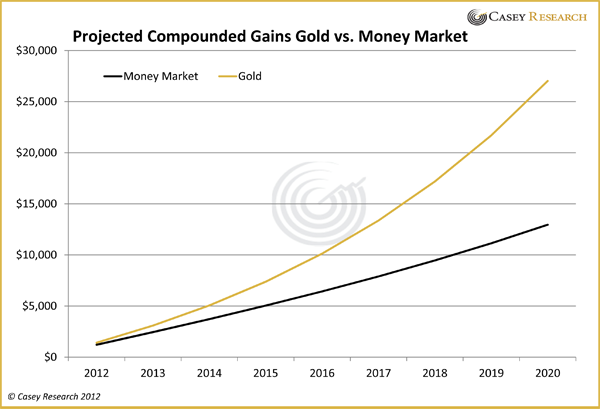
Jeff Clark, Casey Research : Let's explore the advantages of saving in gold and silver over dollars. Here's a hypothetical look at what could occur over the remainder of this decade.

The charts below compare saving $100/month in gold and silver vs. an interest-bearing money-market account. For our projections, we assumed gold's average annual gain of 18% since 2001 will continue through 2020. For the money-market account, we used an annual interest rate of 1% in 2012 and added 0.5% each year, so that by 2020 it's earning 5%.

Here's what would transpire by 2020:


If you invested $100/month from January 2012 through December 2020, your total contributions would amount to $10,800. In the money-market account, your savings would compound to $12,959.48, for a gain of 20%. For gold, however, the value of the metal would reach $27,025, for a return of 150.2%.

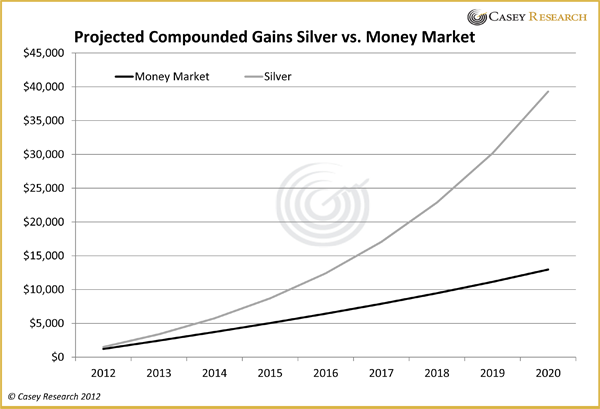
For silver, we'll assume it matches its 25.3% average annual gain from the last ten years through 2020. Here's how it would stack up against money saved in a money market account.


The money-market account would again gain 20%, but the value of silver would reach $39,302, for a total return of 263.9%.

[We caution against investing more money in silver than gold; the metal is much more volatile, and has large industrial applications that could hinder the price in a poor economy. And if fear is high, gold will be sought before silver.]

As you consider these data, keep in mind the power of dollar-cost averaging. Using this strategy to accumulate gold and silver will lower your cost basis automatically because you'll buy more ounces when prices are low and less when they're high. And that highlights another gain: Buying systematically removes emotion from the equation. "Buy on dips" is good advice, but it doesn't tell you exactly when to buy. A commitment to dollar-cost averaging eliminates that question.

You may argue that interest rates will be higher later this decade, and you'll probably be right – but we offset that likelihood by excluding any mania in precious metals. Also, taxes must be considered, as rates are higher on capital gains for gold and silver than for passive income, yet you'd still be left with a much greater return.

At the risk of repeating ourselves, at this point, with the monetary and fiscal predicaments confronting many of the world's governments, and the probable responses they will employ, we recommend a good chunk of your savings be held in gold and silver.

Is There a Best Time of the Month to Buy Gold and Silver?

If you're going to dollar-cost average your purchases, it might be useful to know if there are days of the month that are better to buy than others.

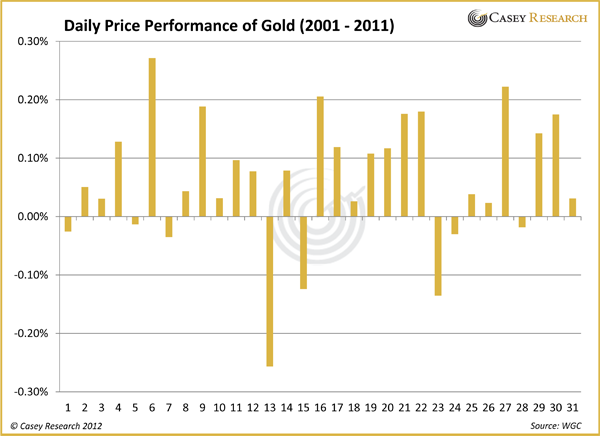
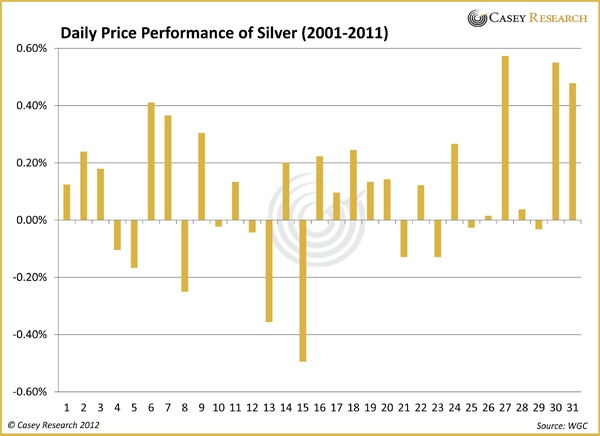
We measured the performance of both gold and silver for each day of the month from 2001 through 2011, and then calculated the average daily return.

Here's what we found for gold.


Clearly, the 13th, 15th, and 23rd are ideal days to buy since the price tends to be the weakest.

Here are the data for silver.


The 13th and 15th again stick out as good days to buy.

If you're accumulating on a weekly basis, we found Tuesday is the weakest and thus a good time to buy (as well as Friday for silver).


A few things to consider if you decide to use this information:

The figures are averages, so there are days when prices bucked the trend. View these results as tendencies, not certainties.
  • These days might fall on weekends or holidays and so won't be available every month.
  • The calculations use daily closing prices, which would be almost impossible for an investor to match.
  • The results measure past performance and can't predict the future (though we see no reason for a significant shift).
That said, if you arrange to buy gold on the 13th and silver on the 15th of each month – or on Tuesday for either metal if buying weekly – your cumulative gains stand a statistically greater probability of being slightly higher. Again, your mileage may vary.

[Jeff Clark and Louis James, both on Casey Research's metals team, do their best to wring actionable ideas out of every possible bit of information they find regarding precious-metals investments. And now you have an unprecedented opportunity to hear them discuss their ideas and maybe even answer your question. Learn more, then act fast – you must sign up by midnight EDT on Friday, April 6.]

Article from The Market Oracle

Monday, April 02, 2012

PRECIOUS METALS: Gold Futures Lock In Gains


April 2, 2012, 2:11 p.m. ET
Article from The Wall Street Journal

-- Comex June gold up 0.5% to $1,679.70
-- Funds favor gold amid second quarter asset allocation
-- Gold strengthens as dollar moderates against other currencies

By Tatyana Shumsky 
Of DOW JONES NEWSWIRES 

NEW YORK (Dow Jones)--Gold futures settled higher Monday, drawing strength from new inflows of investment funds at the start of the second quarter as well a steady dollar.

The most actively traded contract, for June delivery, settled up $7.80, or 0.5%, at $1,679.70 a troy ounce on the Comex division of the New York Mercantile Exchange.

An inflow of investment funds stirred up gold prices. Fund managers flocked to the precious metal market with second quarter allocations on the first day of the new quarter.

The yellow metal locked in a 6% gain in the first quarter, and "performance seems to continue to attract investors," said George Gero, vice president with RBC Capital Markets Global Futures.

"Everybody is hoping you're going to do better and more money is coming in," he said.

Gold prices were also helped by a mixed performance by the dollar, which gained against the euro but retreated versus other major currencies. The ICE Dollar Index was recently at 78.877, from 78.949 late Friday.

Gold's rally was muted, however, as many buyers in India remain on the sidelines amid strikers over a gold import tax hike introduced last month. India is the world's largest importer of physical gold but many jewelers there have shut shop in protest over doubling gold import duties to 4%.

"The speculative trade is still concerned about the potential slackening of physical gold demand from key consuming nations such as India...and about waning investment demand," said Jon Nadler, Senior Metals Analyst at Kitco Metals Inc. North America, in a note.

Chinese market participants were also absent from the gold market overnight as the three-day Tomb Sweeping holidays began there.

"A quiet overnight in Asia, with Chinese players out for the next three days, saw gold come under some pressure," said Marc Ground, metals analyst with Standard Bank, in a note.

Traders in China are due to return to the precious metals market Thursday.

Elsewhere, Bank of America Merrill Lynch cut its 2012 gold outlook Monday. The bank now expects gold prices to average $1,750 a troy ounce, down 5.4% from its previous forecast of $1,850 a troy ounce.

Despite the downgrade, the bank maintained its $2,000 a troy ounce 12-month price target.

"The likely deceleration of US growth, a potentially pro-active Federal Reserve and continued negative real interest rates in a host of nations suggest we are on track to reach our $2,000/oz price target in the next 12 months," Bank of America Merrill Lynch metals strategist Michael Widmer said in a note to clients.

Other precious metals also finished higher on the day. Silver for May delivery settled up 1.9% at $33.098 an ounce, while July delivery platinum gained 0.7% to end at $1,654.90.

"Silver-based ETFs added 22.6 tonnes to their holdings, [but] the futures market remains unconvinced about silver's near-term price prospects. A similar lack of confidence appears to be on display in the platinum market, judging by the sharp decline in the metal's net speculative length in the week ending last Thursday," said Kitco's Nadler.


Settlements (ranges include open-outcry and electronic trading): 
London PM Gold Fix: $1,677.50; previous PM $1,662.50 
June gold $1,677.50, up $7.80; Range $1,664.40-$1,685.40 
May silver $33.098, up 61.4 cents; Range $32.340-$33.250 
July platinum $1,654.90, up $10.80; Range $1,640.50-$1,659.90 
June palladium $658.80, up $4.70; Range $651.50-$666.10 

-By Tatyana Shumsky, Dow Jones Newswires; 212-416-3095; tatyana.shumsky@dowjones.com

Article from The Wall Street Journal

Sunday, April 01, 2012

Nations Put Pressure On Gold


By Resource Investing News   03/29/12 - 02:30 PM EDT
Article from The Street 

By Michelle Smith — Exclusive to Gold Investing News

Nations Put Pressure on GoldNational news put pressure on the gold markets last week. India and China, the world's top gold consumers, both received blame for inciting demand fear. India's contribution came in the form of gold-related protests, while China's damper on the market was connected to manufacturing data that reignited fears of an economic slowdown. Added to these events was news of a military takeover in Mali, Africa's third-largest gold producer.

Last week began with, and saw the continuation of, a gold strike in India that involved jewelers and bullion dealers closing their shops and staging demonstrations. India's gold industry outrage is the result of government attempts to steer the nation's cash away from gold using tax increases.

India has a swelling current account deficit, but its citizens have a penchant for gold, which the government recognizes as exacerbating the problem. The Economic Advisory Council (EAC) calculated that gold imports up to January of this year had reached $50 billion, and are expected to be $58 billion for fiscal year 2011/12, which ends on March 31.

Gold, seen by most Indians as an investment, is increasingly viewed by the government as an unproductive use of financial resources. For the most part, it's purchased - consuming cash - and held by its owners, thereby failing to provide the nation with any economic benefits.

“There is clearly [the] need to examine and rectify the situation so that household savings come back to the organized financial market and are used in the creation of the nation's modern infrastructure and industrial base,” an EAC report says.

The Union budget for 2012/13 therefore calls for a one percent excise duty on unbranded gold jewelry and a doubling of the customs duty on gold imports. The move follows a change in duty structure earlier this year that made gold more expensive.

Sheel Chand Jain, President of the All India Sarafa Association, reportedly drafted a letter to officials pointing out that a similar measure had been attempted with regards to jewelry in 1981-82 and had to be withdrawn.

Gold is ingrained in Indian culture, which has led many to believe that the government's initiatives will fall short. Still, the measures are of concern because while taxes may not curb Indians' appetite for gold, higher costs could limit their ability to afford as much of it. For the larger gold market, the result may be significant declines in demand and downward pressure on prices.

China's declining PMI

The gold markets were severely disappointed in China when HSBC's Flash Purchasing Managers' Index (PMI) revealed that manufacturing had declined for the fifth consecutive month. Falling from 49.6 to 48.1, China's PMI is now further below 50, and anything below that level suggests a contraction.

This fall renewed fears that the nation's economy is slowing at a much faster pace than is often suggested. The slowdown is viewed by many as anti-inflationary, and since gold is widely viewed as an inflation hedge, the metal loses appeal when inflationary concern subsides.

Furthermore, there is a saying that as China goes, so go commodities. That the world's second-largest gold consumer appears to have a contracting economy is viewed as overall bad news for gold as it suggests that gold demand is declining.

Mali's military takeover

Last week the military seized power in Mali. This action was reportedly born out of frustration among soldiers who have been fighting against Tuareg rebels seeking independence, but feel the government has failed to provide them with adequate arms and ammunition.

This news had a negative impact on the shares of gold mining companies operating in the nation, and analysts and investors appeared concerned about the impact this political problem could have on sales and perception.

Especially hard hit was Randgold Resources (LSE:RRS,NASDAQ:GOLD) whose stock saw a 13 percent drop on Thursday. Over 5.8 million shares were traded in the two days following the military action as opposed to a three-month average of about 600,000 shares.

JP Morgan downgraded Randgold's stock from neutral to underweight and Citigroup changed its rating from buy to neutral.

A number of other miners operating in the country saw weakness in their shares following the event, including Cluff Gold (LSE:CLF,TSX:CFG), IAMGOLD (NYSE:IAG,TSX:IMG), AngloGold Ashanti (NYSE:AU), and Avion Gold (TSX:AVR,OTC Pink:AVGCF).

Several of these companies, including Randgold, issued statements saying they are monitoring the situation, but operations are continuing normally.

Gold Fields (NYSE:GFI), which also witnessed stock price declines after the takeover, is an exception. The company reportedly stopped drilling at its Yanfolila exploration site. At the time of publishing, the company had not responded to requests for more information about this decision.

The initial shock in the equity markets appears to have faded rather quickly, and most of Mali's gold miners are on much better footing now than they were immediately after the event.

The story is still developing, but the international community has quickly snapped into action with the African Union suspending Mali, and the EU, World Bank, and African Development Bank cutting off Mali's development aid.

This week it was announced that the airport would partially reopen for civilian transport. It remains unclear when the borders, which were also closed, will be reopened.

Takeaway for investors

Emerging nations are increasingly relied upon to play key roles as both consumers and suppliers. With that dual expectation comes the growing ability of emerging nations to impact global markets. India, China, and Mali's national news highlights that and serves a reminder that despite popular sentiment or comfort levels, there are still notable financial and political risks associated with emerging markets, and assessment of them is an ongoing requirement.

Securities Disclosure: I, Michelle Smith, do not hold equity interests in any of the companies mentioned in this article.

Article from The Street